Wednesday, April 14, 2010

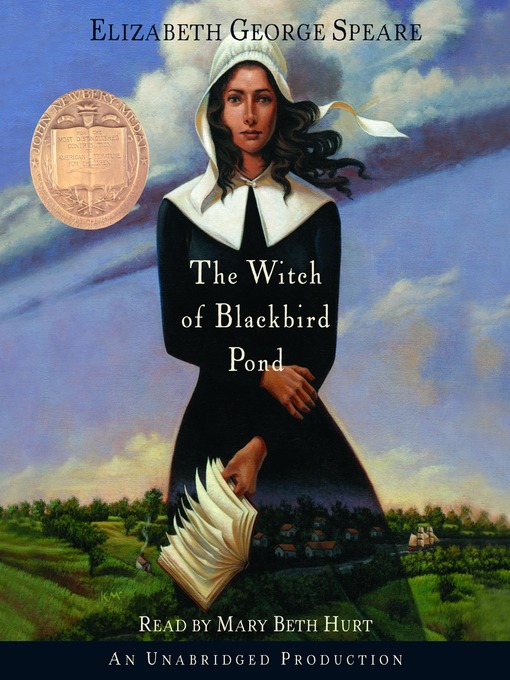
The Witch of Blackbird Pond

Bibliography:
Speare, Elizabeth George. 1958. The Witch of Blackbird Pond. Boston, MA: Houghton Mifflin. ISBN: 0440995779

Plot Summary:
Katherine Tyler, also known as Kit, makes an impetuous decision to leave the island of Barbados where she has grown up after her grandfather dies. She boards a ship for the Connecticut colony, where her mother’s sister now resides, upon which she meets John Holbrook, a divinity student, and Nat Eaton, the son’s captain. Kit makes an impression on all she meets, first by swimming (which is known to be a trait of witches) and also by the way in which she dresses. She arrives unannounced, although not entirely unwelcome, to her aunt’s house and begins to learn about the way that they live. Puritanical through and through, Kit and her straight-laced uncle find fault with one another.

As Kit begins to get into the habit of day to day living with her new family, she finds refuge in the sprawling green sea that is the Great Meadows. There she meets and finds a kindred spirit in Hannah, the one known as the witch of Blackbird Pond. They begin to build a relationship and take care of and teach a young girl, Prudence, whose mother despises Kit, Hannah and berates Prudence. After a sickness overtakes the young of the town (leaving Kit’s own favorite cousin, Mercy, near death), Hannah is targeted as the culprit of the plague, resulting in her house being burned to the ground. Hannah escapes thanks to a quick thinking Kit, who leaves her in the care of their mutual friend, Nat. Kit herself is accused of witchcraft and is taken into custody, but is proven to be innocent with help from her friend Nat. She finds herself longing for home and makes a plan to leave, but not before seeing her two cousins married and finding love for herself in the process.

Critical Analysis:
Many different aspects of colonial life are woven through this story, but the main storyline of being a fish out of water will resonate with the young adult audience. Kit finds herself in situations that she is unfamiliar with, from clothing to church-going, and she finds she needs to learn or re-learn many aspects of her life. Use of language, such as thee and thou, as well as incorporation of terminology from the time period help to flesh out the story and create a vivid depiction of the sometimes stoic nature of the colonialists. Vocabulary and historical accuracy lend well to stylizing the story, but the author does not forget that it is a sixteen year old girl that is relating the story to the reader. The reader is able to identify with the feelings that Kit has, regardless of the fact the story is taking place in pre-Revolutionary America.

Of most importance, the story rings authentic. Kit is thrust into a very different kind of life than she was exposed to before and struggles with the newness of the situation daily. She wishes to fit in with her new surrounding, but not without forsaking her values, morals or, most of all, who she truly is. Kit makes the decision to befriend someone she finds worthy of her time, without regard to what others have said. Above all, Kit stays true to what she believes and this is something that the reader can easily see and identify with on all levels.

Awards and Reviews:
A Newbery Medal Book
An ALA Notable Children's Book
Kansas William White Master List

"Strong plot, fully-realized characters, and convincing atmosphere distinguish this historical narrative of a girl whose rebellion against bigotry and her Puritan surroundings culminates in a witch hunt and trial." - Booklist

"This book has a lively plot and excellent characterizations. The background has every dimension of reality." - The New York Times

Connections:
*What was life on a boat like? Kit had to travel a great distance on a ship, so what are some of the things she may have encounter on the voyage? Have the children do a little research on boats and life on a ship to find out the answers to these questions.
*Being accused of being a witch was serious business during the time in which Kit lived. Read true stories of witch trials (be cautious of the material, depending on the age group) and write a reader’s theater starring the kids. Ask questions that get them thinking about what they would do if they were in the same situation as Kit or someone accused of such a crime.

Book jacket found on: http://images.contentreserve.com/ImageType-100/1191-1/%7B2BCDAE51-9941-417D-89E0-45DA5DE44162%7DImg100.jpg

Don't You Know There's A War On?

Bibliography:
Avi. 2001. Don’t You Know There’s A War On?. New York, NY: HarperCollins. ISBN: 0380815443

Plot Summary:
Sixteen year old Howie Crispers recalls the year he was in Ms. Gossim’s fifth grade class, which was in the middle of World War II. His father is away fighting in a sub, his mother is working at the ship yard and he is left to his own devices. On his way to school one faithful day, he discovers (by climbing down a coal shaft and lifting himself up in a dumbwaiter) that his teacher was going to be fired. Aghast, Howie goes to school, knowing that the teacher he finds beautiful and nice will be let go.

Eventually, Howie finds out during a mandatory blackout that Ms. Gossim is pregnant and her husband is missing in the war. Ms Gossim’s pregnancy is the reason that she is being released. Howie rallies the students to write a petition to persuade the principle to let Ms. Gossim stay, even though Ms. Gossim has asked that Howie not tell the other students about her condition. Not to be dissuaded, Howie gathers a small group of his classmates, marches to the door of the superintendent and successfully pleads with her to allow Ms. Gossim to stay.

Critical Analysis:
What is most striking about this work is the way in which the characters speak; children use slang in speaking with one another, as well as with adults. This sets the story and allows the reader to truly find the voice of the main character. While World War II is happening and everyone is involved, the story is really about choosing to do what is right, regardless of the consequences. Instead of centering on the war itself, the story focuses on Howie and the decisions he makes. The war is never far behind, however, since Howie expresses worries about his father, goes through a blackout and finds out that his best friend’s father dies while serving in the war. Brooklyn landmarks are incorporated, to give the story’s setting an even greater depth.

Awards and Reviews:
Children's Choice nominee, Oklahoma
Children's Choice nominee, Missouri
Children's Choice nominee, Virginia

“His voice is fresh with the wholesomeness of 40s slang and the ageless irreverence of just being a boy. Especially well-crafted are lifelike dialogues that zip with brevity and wit that will keep readers grinning.” – Betty Hicks, Children’s Literature

“Howie Crispers narrates Avi's poignant, funny coming-of-age tale set in Brooklyn during WWII. For the facts, readers can consult Stephen E. Ambrose's excellent volume, but for a flavor of everyday life on the homefront, they will appreciate Howie's recollections of his experiences as a fifth grader during one pivotal week in March 1943”. – Publisher’s Weekly

Connections:
*During the war, even fifth graders were encouraged to help the cause. Investigate some of the things that children were encouraged to do during the Second World War. Pose questions to the students about how they would deal with having to do similar things!
*Newspaper headlines are used as a device in this work – using the Internet and other resources, check different papers for the same week. Compare and contrast the different headlines, then make your own paper!

Book Jacket found on http://www.harpercollins.com/harperimages/isbn/large/9/9780380815449.jpg

Wednesday, March 24, 2010

The Boy Who Invented TV: The Story of Philo Farnsworth

Bibliography:
Krull, Kathleen. 2009. The Boy Who Invented TV: The Story of Philo Farnsworth. Ill. by Greg Couch. New York, NY: Alfred A. Knopf. ISBN: 0375845615

Plot Summary:
Long before the era of instant communication we live in now, there was a time where people would have to wait days, even months, for news, important information or to just be able to speak to a family member. Philo Farnsworth grew up in such a time. As a child growing up in Utah, Philo asked questions about everything and had a desire to know how everything worked. After moving to Idaho, Philo comes in contact with electricity for the first time. Excited to find out how machines work, he even learned how to fix his family’s generation before he was even in high school. He was introduced to the idea of television through a magazine and never stopped thinking about how to accomplish sending images. Encouraged by a high school science teacher and then his wife, Philo continued to work on the idea until he was successful. Captivated with the idea of being able to connect with the world that was around him, it was that inquisitive nature that drove him to invent the technology that would allow the television to become a part of the national lexicon.

Critical Summary:
As a picture book biography, Krull was tasked with making sure that the story of Philo Farnsworth was accurate and interesting without taking liberties for the sake of readability, something with which she finds success. Krull cites her sources and includes a short preface and author’s note, making certain that the reader knows where she received her information. The author’s curiosity and enthusiasm for the subject of her work is clear though the writing, which is concise and informative without sacrificing flow or ease of reading. Vocabulary used in the work could be easily understood by a young reader, the target audience of this work.

The subject of her work is quite young (the tale picks up when Philo was just born), something that she emphasizes throughout the story. This emphasis would not go unnoticed by the intended reader; showing that someone as young as 10 can understand complex concepts, even more so than some of the adults in their lives. Illustrations that supplement the story support the words; the reader truly gains an understanding of what is happening to Philo and what he is feeling through the accompanying picture.

Awards and Reviews:
NSTA/CBC Outstanding Science Trade Book for 2010
School Library Journal Best Book of the Year (2009)
2009 Parents' Choice Silver Honor winner

“Krull's focus is on the boy genius becoming an inventor like his heroes, and only in a note does she mention his struggles with RCA and his bitterness later in life. The facts aren't new, but with Krull building the story and Couch's exceptional images, it's one to inspire young audiences with the vast possibilities that imagination and diligence can accomplish.” – Janet S. Thompson, School Library Journal

“In The Boy Who Invented TV: The Story of Philo Farnsworth, by Kathleen Krull (illustrated by Greg Couch), you have another classic story: the science-loving country boy who solves the puzzle before the professionals, by himself, in the wilds…Beautiful and beautifully told, the book tracks like the sort of graphic novel that breaks your heart, with its implied passage of time and slipping away of early dreams.” – New York Times Review

Connections:
*This work only follows Philo Farnsworth so far, so what happened to him next? Incorporate learning about how to research in an exercise where you task students with finding out what happened to Philo later in his life. (It may be helpful to break into several groups, who are each given a specific question to answer, like did he have any children? If so, how many and when were they born?)
*Check out books about other young inventors, like Thomas Edison or Benjamin Franklin.
*Figure out how a television really works! Gather books that show how a TV puts together the pictures that we see everyday.
*Find other books about inventors of other image capturing tools, like the photo camera and the film camera.

BOOK JACKET FOUND ON: Jacket Flap

Tuesday, March 23, 2010

The Human Body by Seymour Simon

Bibliography:
Simon, Seymour. 2008. The Human Body. New York, NY: HarperCollins. ISBN: 0060555416

Plot Summary:
The human body is comprised of several different systems that work together to let us feel, taste, see, hear and live. In this informational work, a survey of the human body and its attributes are presented to young readers. The reader begins the journey through the body by being introduced to the building blocks of the body: cells. Systems that allow the body to function are briefly mentioned all together, and then each is individually covered in more depth through the rest of the book. From hair, skin, nails and bones to muscles, organs and blood, all major components of the body are presented. Even the difficult concepts of DNA, pain sensation and growth are addressed, in order to give a complete picture of how the body operates from top to bottom.

Critical Analysis:
Made in conjunction with the Smithsonian, it would appear that the accuracy of this science oriented informational book is top priority. While the Smithsonian can be considered an authority, I do take issue with the fact that the resources used to write the work are not included in a bibliography. There are several websites included in the index for further research, but it would have been helpful, especially for the young reader, to find out where this information came from in the first place. Some of the information is “common knowledge” and may not need to be cited, but other, more obscure information should.

The jacket flap of this work indicates that it is geared toward 5-9 year olds, however I find that the wordiness and difficult vocabulary of the text many be too much for the younger range of this age group. Much can be said of not diminishing the text by “watering” down the information, but more simplistic terms could have been used and difficult words could have been further defined. However, some more complicated concepts are broken down into situations and similes more easily understood by the elementary set. The organization of the book lends itself well to focusing on one part or system of the body. There are fantastic close up pictures and diagrams of the topics that are covered in the book, making the words come to life.

Awards and Reviews:
"Simpler than Richard Walker's ever-so-detailed Encyclopedia of the Human Body (DK, 2002) and a nice introduction to Simon's earlier, more specific works, this book is handsome and informative." - Patricia Manning, School Library Journal

"A nice addition is the appended guide to the illustrations, though captions near the pictures and labeling on diagrams would have been even more useful to children. Still, a visually striking guide to the human body." Carolyn Phelan, Booklist

Connections:
*Read some other titles by Simon in the Smithsonian series, like Eyes and Ears, The Brain or The Brain.
*Find other books about the body and break them apart by topic. Cover, in a read-aloud time, different aspects of the body, like the skeletal system or muscles from the various books. Compare and contrast the information that given in each work.
*Build a body! Let each child trace his or herself to make a life-sized cutout on butcher paper. Cover the different body systems over the course of a few weeks and as you discuss each system, the students will add that system to their own cutout. Start with bones and work your way up to the assorted organs.

BOOK JACKET FOUND ON: http://www.harpercollins.com/books/9780060555412/The_Human_Body/index.aspx

Wednesday, March 10, 2010

What My Girlfriend Doesn't Know

Bibliography:
Sones, Sonya. 2007. What My Girlfriend Doesn’t Know. New York, NY: Simon & Schuster. ISBN: 0689876025

Plot Summary:
After a surprise mutual attraction to a popular girl, perennial loser Robin Murphy finds himself navigating the challenging world of high school politics in this verse novel. Robin finds that having a girlfriend can be rewarding, but difficult at the same time. His girlfriend, once well-liked, is now without friends and is getting teased due to the fact she is in a relationship with him. Along the way, Robin is given the opportunity to audit a Harvard art class, where he finds that he fits in well, excels in the assignments and gains some friends. With the weight of his girlfriend’s sudden unpopularity on his mind, Robin feel as if he has to choose between having her in his life or letting her be happy. In the end, their love wins back some of her friends and the admiration of their classmates.

Critical Analysis:
Sones creates the perfect storm in the verse novel Girlfriend; using poetry in a linear format, she tells the story of two teenagers trying their hand at first love. The poems differ in length, format, rhythm and even shape, helping to ensure that the reader does not have a chance to get bored. What is most striking is the emotion that is conveyed throughout the work; the reader truly gets the feelings expressed by the main character. The poems read excitable when Robin is happy and tragic when he is depressed. You get the voice of the character through the poems, not just words and phrases. It does seem, however, some of the poems would be difficult to understand if taken out of the context of the novel.

In a verse novel, the idea of organization is very important, as each poem leads to another conclusion or enlightenment. The way the poems are put together here is in such a way that the reader can immediately engage and follow the story. The topic of the novel is made clear through the tone of the poems and the language used within the work. It feels as if this young man is relating his issues to the reader, not as if an older woman is writing about what she thinks teenagers would think or feel. Appeal for this work would be great among the target audience, mainly because young romance always has an audience.

Awards and Reviews:
Booklist Top Ten Romance Novel – 2007
Quick Pick for Reluctant Young Adult Readers – American Library Association
NY Public Library Book of the Teen Age – 2008
Bank Street Best Book of the Year – 2007
Books-A-Million Book Club Selection – 2008

“Written as a novel in verse, this title is a fast-paced, page-turning romp that gives authentic voice to male youth even when it is painfully truthful.” – Leah Kripper, School Library Journal

“The story of a thrilling and faltering first love may be familiar, but Robin's believable voice is distinctive, and Sones uses her spare words (and a few drawings) to expert effect. From bad puns to breathless accounts of locking lips to anguished worries about losing Sophie, Robin reinforces the picture of an awkward, likable, intelligent, and realistically flawed young man. Many teens will see themselves, and they'll cheer when Sophie and Robin thwart the bullies and reclaim their social standing. Like Sones' other titles, this is a great choice for reluctant and avid readers alike.” Gillian Engberg, Booklist

Connections:
*Read the prequel to this novel from Sophie’s (the girlfriend) perspective, What My Mother Doesn’t Know, also by Sones.
*Have the student choose one of their favorite books and write a companion verse novella from the point of view of a non-main character.
*Compare this work with regular novel on some of the same topics addressed, like first love, popularity or bullying. Try How Not to Be Popular by Jennifer Ziegler or The Clique series by Lisi Harrison.

Book Jacket found on the Sonya Sones website.

Tuesday, March 9, 2010

Spot the Plot: A Riddle Book of Book Riddles

Bibliography:
Lewis, J.Patrick. 2009. Spot the Plot: A Riddle Book of Riddles. Ill. By Lynn Munsinger. San Francisco, CA: Chronicle Books. ISBN: 0811846687.

Plot Summary:
In Spot the Plot, Lewis uses poetry to create riddles about the plots of popular children’s books. Each poem is written about the story line to a specific book; this is done so that the reader is able to put the clues together to guess what book the author is describing. Characters drawn in the book take the form of detectives, who find themselves in the middle of the action of the book they are investigating. From Charlotte’s Web to Where’s Waldo?, some favorite children’s stories are broken down into a interesting game of “What’s That Book?”. The end of the picture book gives a run-down of the correct answers to the riddles.

Critical Analysis:
This book has an interesting concept, in that the poems are created in such a way to give clues to what book the author has in mind. Using poems in this way can give children the idea that poems can be about something specific, while still being abstract and not giving everything away at once. It brings to light how important the use of language within the poem is and of how the use of imagery in poems can paint a picture in a person’s mind. The concept of language and imagery is one of the most important in poetry, something well covered by this work.

The author uses fun rhyming schemes and different types of poems to keep the reader interested and focused. Lewis makes a game of trying to find out what book the poem is about, thereby engaging critical thinking skills by the reader. Illustrations complement each of the poems, giving small clues by providing drawn details of the book in question. In using drawings as reinforcement, a young reader can find picture evidence to back up their theories of what book they think is the answer. Drawings can also assist readers who are lacking in context clue development.

Awards and Reviews:
"There are clues in the text usually emphasized with bold colored letters and pictures that contain a myriad of clues." - Marilyn Courtot, Children's Literature

"The poems are presented in different layouts and are of different lengths, preventing a formulaic feel...this book is perfect for an interactive read-aloud, especially if the illustrations are held back until after the text has been read." - Stacey Dillon, School Library Journal

Connections:
*The obvious way to have an audience connect with this book is to have them guess which book they think each riddle concerns! Each poem can stand by itself, so break up Spot into sections and cover one plot a day. It will give the kids something new to look forward to each day! At the end of the book, assign a project where the kids write their own riddle about a favorite book of their own and draw an accompanying picture.
*Pair each riddle with the work that it is based on: read the riddle and let the kids have a fun time guessing which book the riddle is about. After guessing, read aloud the actual book, then have the kids point out the elements about the riddle that match the book’s plot.
*Using the illustrations, have the kids point out clues within the pictures that match the book. Make a list of things the illustrator could have included, but did not.

Book Jacket found at Chronicle Books.

Shoe Bop!

Bibliography:
Singer, Marilyn. 2008. Shoe Bop. Ill. by Hiroe Nakata. New York, NY: Dutton Children’s Books. ISBN: 0525479392.

Plot Summary:
Once her favorite purple sneakers wear out, a young girl and her mother go to the shoe store to buy a new pair. In searching for a pair of replacements, each pair of shoes is spoken about in verse. From rhyming poems about galoshes to haikus about moccasins, a variety of different shoe types are introduced to the reader. Watercolor picture representations accompany each different poem. Each shoe is tried on and their benefits and limitations are weighed by the young girl. Throughout the work, the young girl notes her love of sneakers and ultimately settles on a pair of bright green high-tops after trying on an assortment of different shoes.

Critical Analysis:
The type of poem used throughout this topical collection is varied, which allows the introduction of different poetry styles to be introduced to a young reader. By using a range of different poem types, the reader is not limited to reading only rhyming couplets or stream of consciousness poems. The book can then be broken up into similar poem styles, allowing an instructor to further investigate the elements of poetry with examples. This picture book also has a verse novel feeling about it, since the story is linear, connected and is only broken up into poems by shoe type.

What I find most interesting about this work is that the same happy, cheery tone resonates throughout all the poems. While not every pair of shoes is a favorite of the main character, the author makes certain to provide positive points for each pair that is tried on. While the type of rhythm and rhyme of the poem changes through the story, the tone and theme remains consistant.

Awards and Reviews:

"This sparkling tale serves as a fun introduction to poetry as well as a paean to the undeniable appeal of new shoes." - Kirkus Reviews

"The shopping expedition is related through a series of 29 linked poems, and the rhythms are witty and always boppy. Nakata's vibrant, stylized watercolors are a perfect match for the bouncy text. With curricular connections to shoes and poetry, this book is a natural fit for classrooms." - Kathleen MacMillan, School Library Journal

Connections:
*After reading Shoe Bop, go through the book and try to identify the different types of poems that were used throughout the book. After compiling a list, get the children to write and read-aloud one poem of their own using one of the styles of poem used in the book.
*Have a read aloud, complete with cut-outs of the style of shoes noted in the book! For each shoe poem, assign a team of children with the task of creating a large representation of that shoe and have them read the poem to the rest of their class.

Book Jacket found on: http://www.infibeam.com/Books/search?author=Marilyn%20Singer